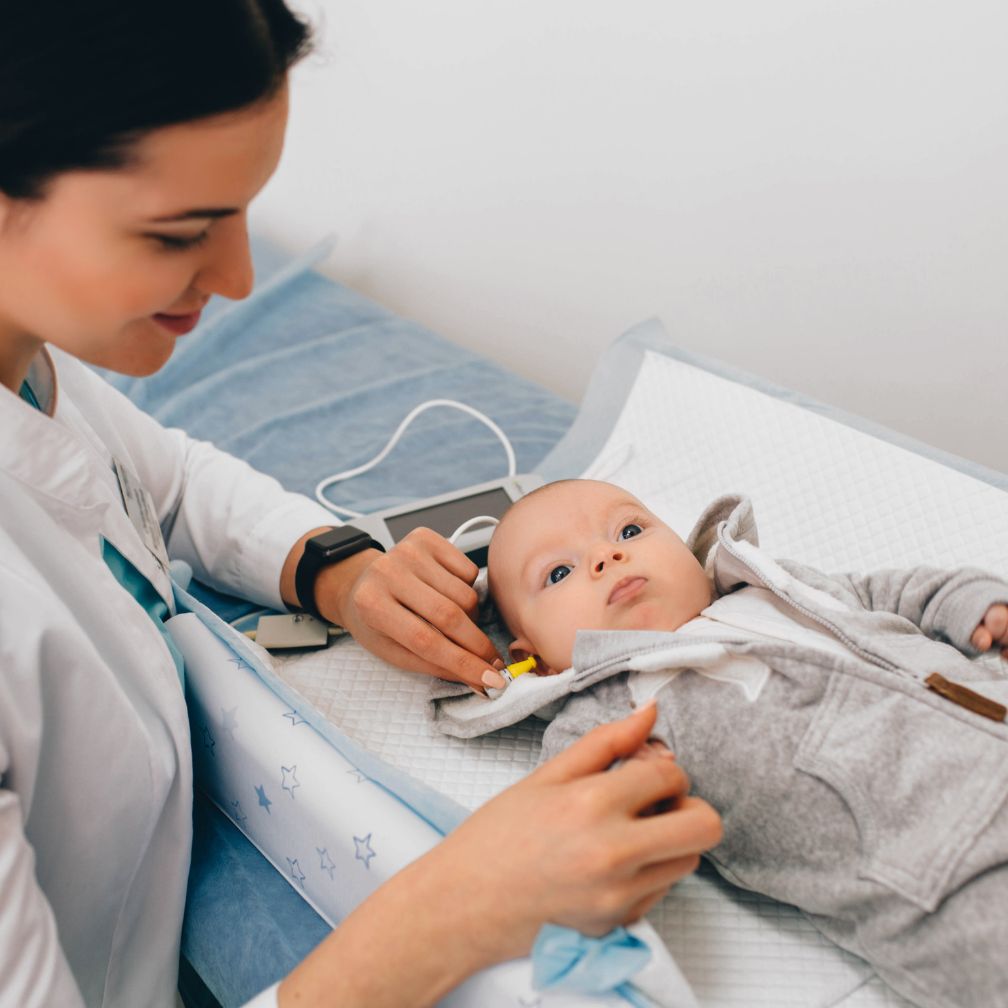
For mothers and fathers of newborns, hearing a medical report of infant hearing loss naturally causes profound stress and concern. Fortunately, the reassuring perspective dictates that through timely checks and early help, babies with hearing issues routinely attain great success. Clearly, such children consistently gain core language skills, social capabilities, and firm bonds with people in their lives, building toward a prosperous life!
Combining custom pediatric hearing aids with surgical cochlear implants represents two premier clinical instruments for assisting infants with hearing deficits. In the upcoming breakdown, we dissect their primary mechanics and detail how to pick the proper device for your child.
Exploring Causes of Auditory Loss in Infants
Hearing impairment in newborn infants can stem from various underlying sources, including:
- Known hereditary genetic markers (even completely lacking any known parental history)
- Targeted in-utero viral infections including cytomegalovirus (CMV) and rubella
- Intrapartum events, including fetal oxygen deprivation or early delivery
- Particular ototoxic pharmaceuticals administered in dedicated newborn intensive units
Which effort carries the greatest weight? Prompt clinical evaluation. For these reasons, infants within United States birth units undergo auditory screening before going home. Pediatric audiology specialists faithfully maintain the official “1-3-6” operational timeline:
- Baseline screening executed within the first month
- Confirmed hearing diagnosis confirmed within 90 days of life
- Formal intervention (deploying corrective equipment or speech habilitation) commenced within 6 months
Hitting these clinical targets provides infants an unparalleled opportunity for normal speech, expressive language, and cognitive progression. Should you require assistance with these newborn checks, your family pediatrician stands eager to guide you!
Deploying Hearing Aids for Newborns
For babies with mild to severe hearing loss, wearable hearing aids routinely serve as the first line of treatment. These small, custom-fit devices amplify incoming audio helping infants distinguish human speech and natural sounds more clearly.
Custom infant-adapted hearing aids act as:
- Fully safe and suitable for infants just several weeks of age
- Engineered with flexible, gentle ear impressions that update as the baby matures
- Engineered with tamper-proof battery doors plus specialized safety features geared toward babies
- Individually adjusted by a trained pediatric hearing practitioner to match your child’s exact hearing needs
While your infant develops, wearable units demand periodic adjustments to ensure proper fit and effectiveness.
Pediatric Cochlear Implants: An Advanced Solution
If a child experiences severe to profound sensorineural hearing loss and fails to show adequate progress with standard hearing aids, a cochlear device can be prescribed. In direct contrast to external acoustic hearing aids, modern cochlear implants:
- Require a specialized surgical operation for precise fit executed by a pediatric specialist
- Route around damaged areas inside the inner ear anatomy
- Convert sound into electrical signals that activate the hearing nerve directly
Surgically placed cochlear implants are:
- Granted official FDA clearance for infants starting at 9 to 12 months old
- Profoundly successful when paired with early auditory-verbal therapy and active household backing
- Sanctioned strictly following a rigorous evaluation process by an expert audiologist and ENT specialist
That multi-step journey involves neuroimaging scans, detailed hearing tests, and detailed consultations regarding anticipated long-term progress.
Hearing Aids Versus Cochlear Implants: A Direct Comparison
- Mild to severe hearing loss targets Hearing Aids; Severe to profound hearing loss necessitates Cochlear Implants
- Non-Invasive wearable design: Hearing Aids; Surgical internal implantation: Cochlear Implants
- Acoustic volume boosting: Hearing Aids; Electrical signal stream conversion: Cochlear Implants
- Usage can begin in early infancy: Hearing Aids; Surgery can begin at 9-12 months: Cochlear Implants
Concluding Guidance on Pediatric Hearing Technology
Should your baby receive a formal hearing loss diagnosis, remember that proven treatment choices and dedicated care teams are available. Through the guidance of experienced pediatric audiology teams, a vast majority of children attain language capabilities completely equal to their hearing peers.
Irrespective of whether your child receives fitting for hearing aids or surgery for cochlear devices, taking immediate action produces a lifelong positive impact.
Have you got specific questions concerning your newborn’s hearing abilities? Connect with our office today to obtain an exhaustive evaluation and custom-designed care plan.